
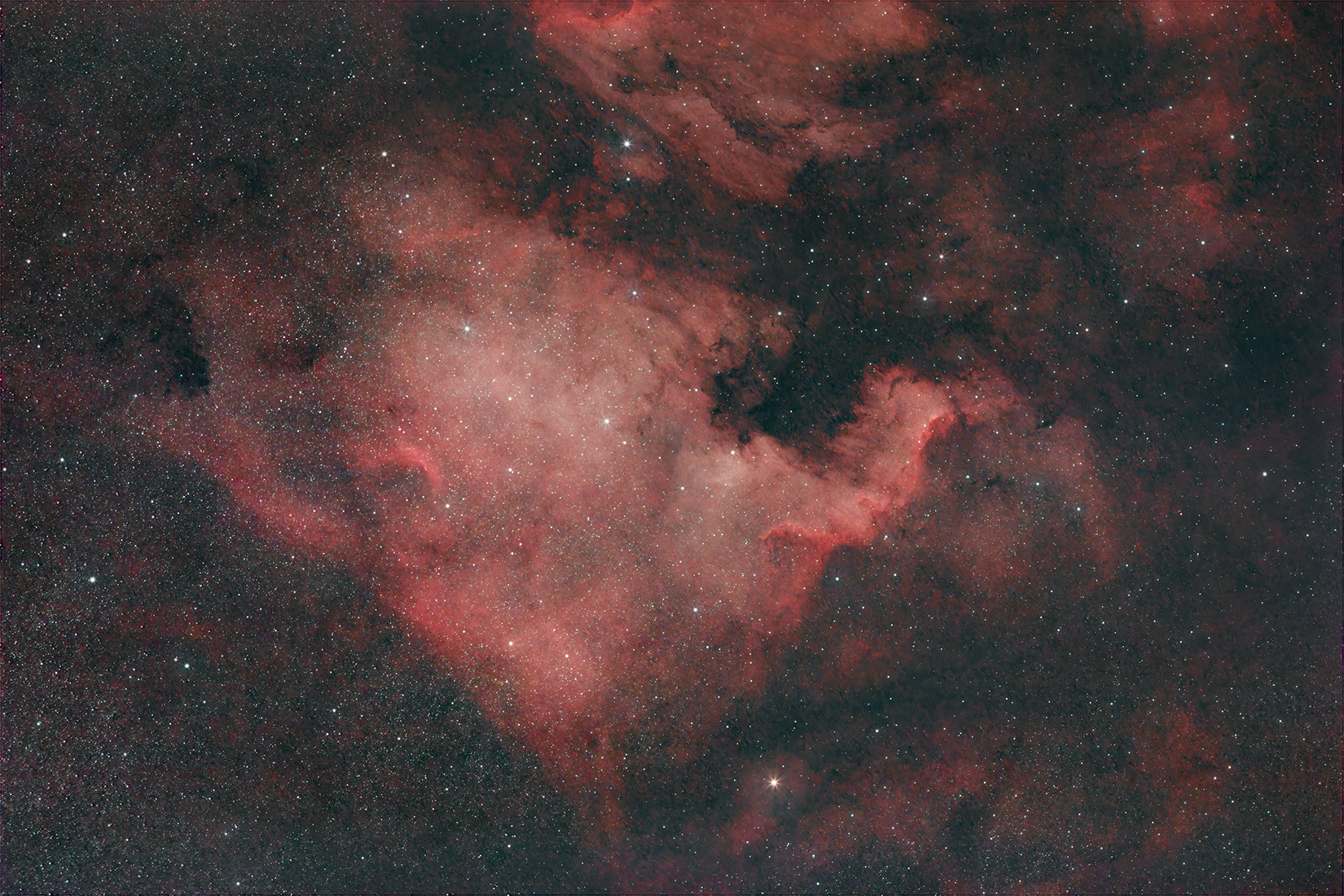
2020-05-31 – North American Nebula
The North American Nebula (NGC7000) is a very large Hydrogen emission nebula in the constellation of Cygnus. Its name derives from its similarity to the North American continent – particularly the area around the Gulf of Mexico. To get some impression of the size of the nebula, the full moon would fit into the gulf area. This image was taken with a 300mm camera lens – the nebula is too large to fit in the field of view of most telescopes. At the top of the picture, a part of the neighbouring Pelican Nebula can be seen, and an even shorter focal length would be required to also fit this into the image. The two nebula are actually a single cloud of gas, but appear to be separated due to intervening dark dust clouds which hide the central area of the nebula complex.
The North American Nebula lies at a distance of 2,600 light years and is about 90 light years across. The region resembling Central America is known as the Cygnus Wall, and is currently an area of active star formation. Hydrogen gas clouds that are ionised are known as HII regions (H1 being normal non-ionised hydrogen). The characteristic red colour is produced as electrons re-combine with the ionised gas, emitting radiation at a characteristic wavelength known as H-alpha, which is at the extreme red edge of the visible spectrum. A source of energy is required to ionise the gas and this is usually provided by new bright stars that form out of the gas cloud. The source of ionisation of the North American nebula was a puzzle to astronomers for many years, however it is now believed that it is an insignificant appearing star in the dark cloud region between the North American and Pelican nebula. Most of the light from the star is attenuated by the intervening dust, so it only appears as a 13th magnitude star from Earth, however if we saw it undimmed, it would shine at third magnitude and be the brightest star in the image. All the other stars in the dark regions are in front of the dust clouds.
The H-alpha emission line is towards the limit of red light that the human eye can see, and to mimic the sensitivity of the human eye, camera manufacturers introduce a ‘red roll off’ filter that reduces the sensitivity of the sensor at those red wavelengths. This is unfortunate for astro-photography as it means that a normal camera rejects about 65% of the H-alpha light. It is possible to modify a camera by removing this roll-off filter, which increases the sensor sensitivity to H-alpha by a factor of about 3, however the North American Nebula is so bright that a lot of detail can be captured even with an unmodified camera. In this image, I used a CLS light pollution filter which removes a lot of orange light pollution, giving more contrast to the nebula. It does however create a very strong blue colour cast, which has to be removed. Another problem with photographing the North American Nebula is that it lies in a very rich area of the Milky Way, so it is easy for the image to become over-powered by the sheer number of small stars. This image was originally processed using Photoshop, but I have re-processed it using specialist astro-processing software called PixInsight which provides methods to reduce the impact of stars and reveal more of the nebula detail.
Image Details
- Date: 11th, 29th & 31st May 2020
- Exposure Details: 51 x 300s, F5.6, ISO400
- Total Integration Time: 4hr 15min
- Camera: Canon EOS80D (unmodified)
- Telescope: Canon 300mm F4 L-series lens.
- Mount: Skywatcher HEQ5
- Guide Scope: Skywatcher 50mm Viewfinder Scope
- Guide Camera: QHY5LII