
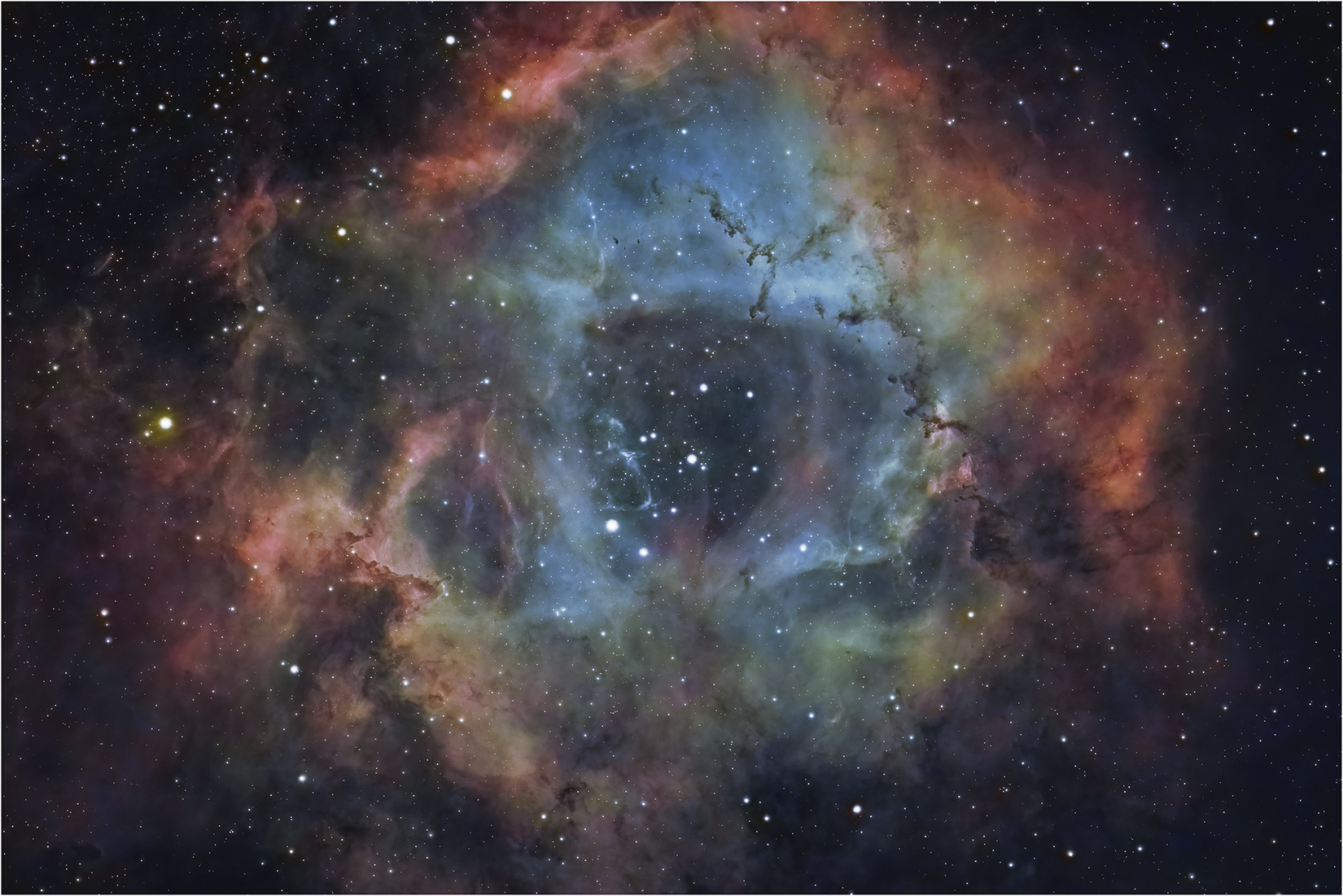
Rosette Nebula – 29th Dec 2025
The Rosette Nebula is a large area of nebulosity located in the rather dim constellation of Monoceros, to the left of the star Betelgeuse in Orion. In addition to its NGC (New General Catalogue) number, the nebula is also known to amateur astronomers as Caldwell 49, whilst the star cluster at its centre is Caldwell 50. Caldwell was Patrick Moore’s middle name, under which he published a selection of targets for amateur astronomers.
The nebula is about 5,000 light years from Earth and is about 130 light years across with a mass 10,000 times that of our sun. This makes it considerably larger than the much closer and brighter Orion Nebula. The hollow appearance of the nebula arises because the stars that have formed in the centre of the gas cloud are now in the process of dispersing the gas, and after about 5 million years have largely cleared the central region. As the gas gets blown outwards, it also becomes compressed, and this encourages more stars to form, so stellar formation will continue outwards before the gas is finally dispersed. The bright central stars are responsible for ionising the gas cloud, which then emits radiation at specific wavelengths of light, which depends on the chemical make-up of the gas. The most important of these wavelengths is H-alpha, emitted by ionised Hydrogen, which is at the extreme red end of the visible spectrum.
The nebula is called Rosette partly because of its shape, which is slightly reminiscent of a rose, but also for the strong red colour of the H-alpha emission. Unfortunately, with an unmodified DSLR, much of this red emission is not captured by the camera, as a standard DSLR has a filter specifically to blot out this red end of the spectrum. To fully appreciate the nebula therefore requires either a modified camera with the red filter removed, or a dedicated astro camera.
This image has undergone a series of updates, which illustrates that an astro image is never really finished. The original colour data was captured with an unmodified Canon EOS80D, which captured the essential shape of the nebula, but lacked both the full red colour and the finer detail. About a year later, I revisited the target with an astro-modified camera and an H-Alpha filter to isolate the red hydrogen light from the background. This provided much more of the red data and more detail. I then re-processed the image, but biased the colours to bring out a slight greenish hue in the centre of the nebula. Finally, I re-visited the target again with a cooled mono astro-camera, which provided a massive improvement in detail. I could then use this new H-alpha data as a Luminance channel, and take the colours from the DSLR images. This time, I pushed the greenish hue more towards blue to try to simulate an SHO (Sulphur, Hydrogen, Oxygen) colour palette. So this image has been constructed over a period of about 4 years, using three different cameras.
Image Details
- Date: 10th Feb 2021,
- Exposure Details: RGB: 20 x 300s, F6, ISO400. Initial H-Alpha: 13x900s, F6, ISO400. H-Alpha Luminance: 15 x 500s, F6, Gain 400.
- Total Integration Time: 1hr 40min + 3hr 15min + 2hr 5min = 7hrs
- Cameras:
- RGB Data: Canon EOS80D (unmodified)
- Initial H-Alpha Data: Canon EOS100D(modified)
- H-Alpha Luminance Data: Altai Astro 183M Cooled Astro Camera
- Telescope: Altair Astro 72EDF at 432mm focal length.
- Mount: Skywatcher HEQ5 and Skywatcher 150i.
- Guide Scope: Altair Astro 60mm
- Guide Camera: QHY5LII