
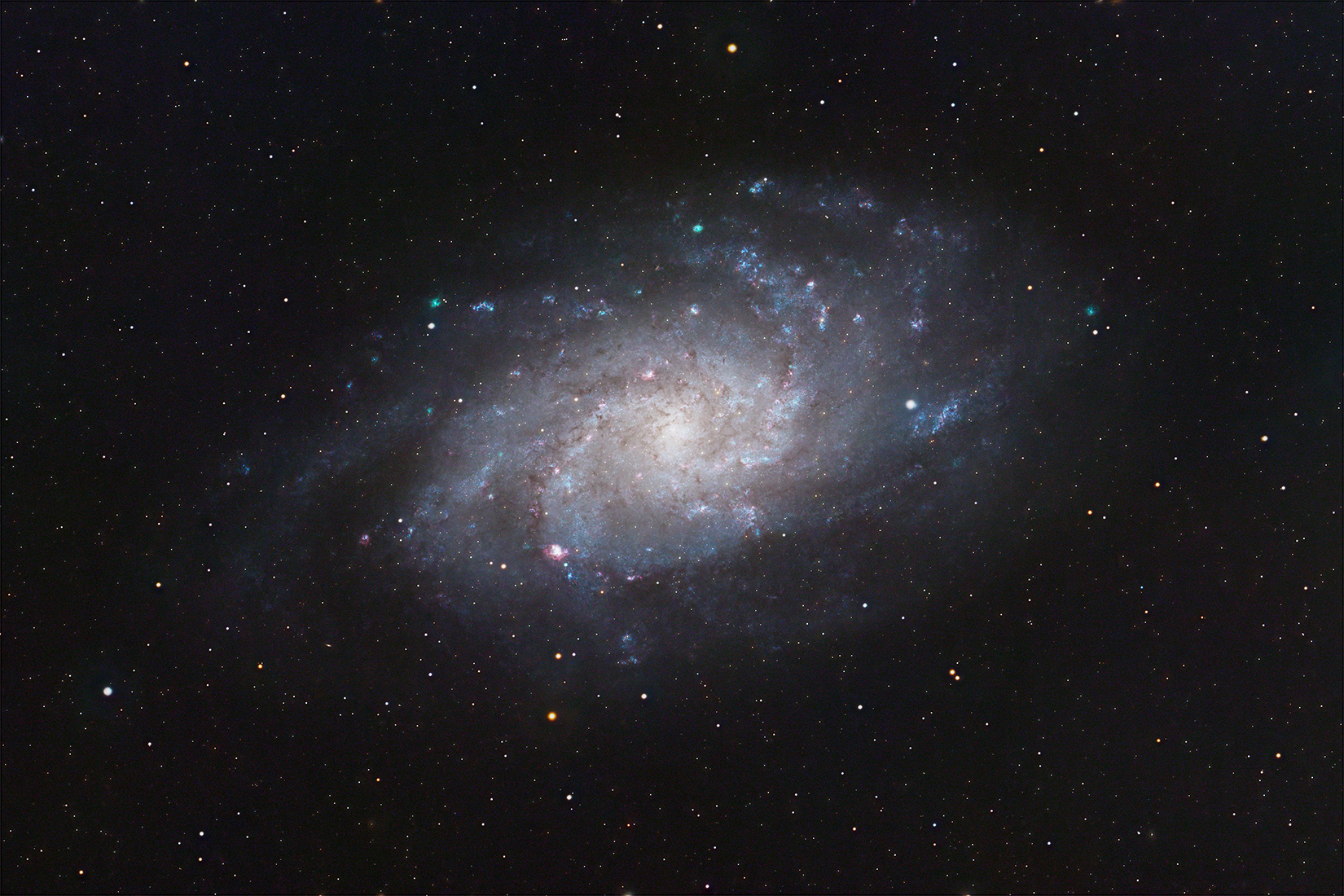
Triangulum Galaxy – 29th Nov 2025
The Triangulum Galaxy is located in the small constellation of Triangulum, a little way south of the larger and better known Andromeda Galaxy. It is the third largest spiral galaxy in our small local cluster, at about half the diameter of the Andromeda Galaxy and our own Milky Way. At a distance of 2.7 million light years it is a little further away than Andromeda and is the most distant object that can be seen with the naked eye – but only under excellent viewing conditions.
Despite being just visible to the naked eye, it was probably first recorded in 1654 by Italian astronomer Giovanni Battista Hodierna, but was later re-discovered by Charles Messier in 1764 and included in his catalogue as M33. Towards the end of the 18th Century, William Herschel studied the galaxy and allocated four areas of bright Hydrogen nebula their own NGC designation. The largest and brightest being NGC604 (located below left of the core in the image above). This is one of the largest Hydrogen gas clouds known at about 1500 light years across. In 1850, Lord Rosse identified the spiral nature of the galaxy – one of the first spiral galaxies to be classified.
Measurements of its location and movement suggests that the Triangulum Galaxy is gravitationally bound to the Andromeda Galaxy and indeed may have interacted with it in the past. It is likely that within the next 2.5 to 5 billion years it will collide and merge with Andromeda, probably also participating in the merger of Andromeda and the Milky Way into a single large galaxy.
Galaxies are ‘wideband’ targets – ie photographed across the full spectrum of light. This means that with my Bortle 5 skies, Light Pollution introduces significant noise. The best way to overcome this is to expose for longer because in theory, the signal-to-noise ratio in an image improves with the square root of exposure time, so adding more exposures should lead to a better image. I first attempted to photograph Triangulum towards the end of 2023, but did not think I had enough data to process the image properly. Therefore when the galaxy came around again at the end of 2024, I gathered more data to add to the original set. Still not satisfied, I added a further 3 night’s of data in 2025. This is the first time I have combined data taken at widely separated times, the final image being better than the earlier sets of data processed individually.
The gains and exposure times from each session were different (due to me trialing different combinations), so the images for each filter from each night were stacked individually to create a Master Image for each channel for that night, then the Master Images were combined into a ‘Super Master’ using a weighting based on each night’s exposure time. Finally, the full colour image was created by combing the Super Master LRGB channels into a single image. It seems complicated, but just requires keeping track of the exposure times. All processing was performed in Pixinsight.
Image Details
- Date: 13/12/2023, 27/11/2024, 16-20/11/2025.
- Telescope: Altair Astro 72EDF. Focal Length: 432mm, Aperture: F6.
- Camera: Altair Astro 183MM Cooled Mono Astro Camera. Offset 40, Temp -10degC. Gain 100 for 2023 L-Pro data, 400 for 2023 Colour data, 200 for all later data.
- Filters: Luminance: Optolong L-Pro. RGB – Optolong RGB Filters.
- Mount: Skywatcher HEQ5.
- Guide Scope: Altair Astro 60mm.
- Guide Camera: QHY5LII.
- Exposure Details: L: 54 x 60s + 443 x 80s (10.7hrs), R: 26 x 60s + 21 x 120s + 85 x 80s (2.9hrs), G: 26 x 60s + 14 x 120s +92 x 80s (2.9hrs), B: 22 x 60s + 20 x 120s + 103 x 80s (3.4hrs).
- Total Integration Time: 20hrs.